One Truth One
Spirit One Circle
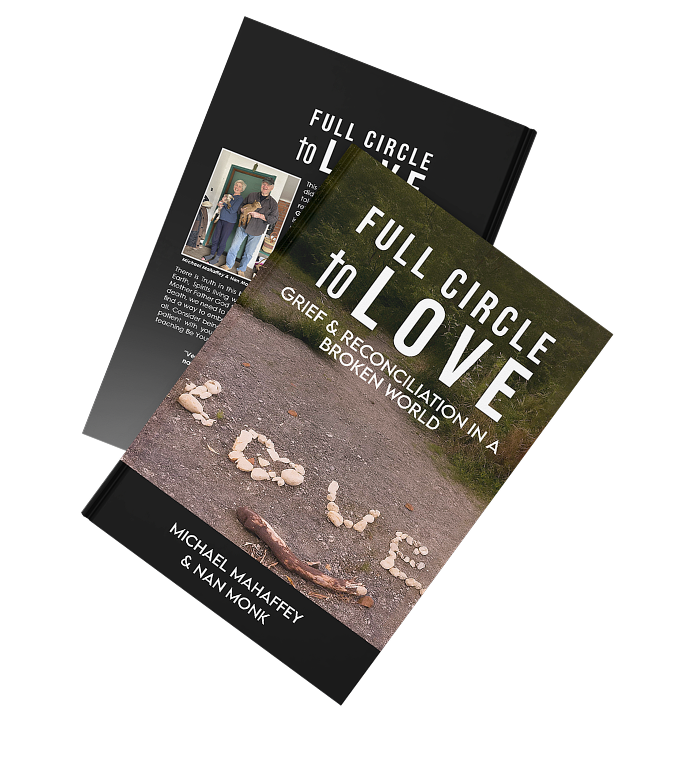
Full Circle To Love
GRIEF & RECONCILIATION IN A
BROKEN WORLD
A Sacred Memoir of Love That Transcends Death
Full Circle to Love documents a lived journey through grief, shaped by devotion, spiritual practice, and intimate dialogue with loss. Written before and after the death of the book unfolds as a series of reflections that mirror grief’s nonlinear rhythm. Each entry captures a moment of surrender, questioning, or revelation as the author learns to remain present while everything familiar dissolves.
The writing moves between memory and prayer, despair and illumination, drawing from Christian mysticism, Indigenous teachings, Alcoholics Anonymous principles, and contemplative silence. Rather than framing grief as something to overcome, the book presents it as a teacher that exposes unconscious patterns and invites deeper alignment with divine love. Love is not sentimentalized. It is tested, refined, and ultimately expanded beyond form.
Throughout the pages, grief becomes a doorway rather than a destination. The narrative honors vulnerability, confusion, and resistance while gently pointing toward trust and spiritual intimacy. Nan’s presence continues not through denial, but through transformation, guiding the author toward a deeper understanding of unity, humility, and service.
Full Circle to Love offers no prescriptions. It offers companionship. It is a sacred witness to what happens when loss is met with honesty, reverence, and the courage to listen for love in unfamiliar ways.
Discerning players will find at imperium 9 casino an environment that stands comparison with well-established brands. Seasonal Advent calendars bring new surprises each day during December. Game show formats such as Crazy Time, Dream Catcher and Monopoly Live offer particular entertainment. Daily, weekly and monthly withdrawal limits depend on the player’s VIP status. The user interface automatically adapts to the screen size of the device. For questions about withdrawals, support typically responds within the same gaming session. An internal newsfeed informs about updates, new games and promotions. Personal player data is stored exclusively in encrypted form. A demo function makes it possible to try games without financial risk. Overall, the platform leaves a mature and coherent impression.

Why Read It?
Full Circle To Love
This book is for those who are grieving without needing answers. It is for readers who sense that loss has depth, intelligence, and spiritual consequence. Full Circle to Love does not rush healing or promise resolution. Instead, it honors grief as a transformative force capable of awakening humility, truth, and deeper connection.
Readers will find language for experiences that often remain unspoken: the collapse of certainty, the longing for presence, the fear of forgetting, and the quiet moments when love feels closer than absence. The book offers companionship through prayer, reflection, and lived vulnerability, allowing readers to recognize themselves without being instructed or corrected.
Rather than separating love and loss, this work holds them together, revealing how devotion can survive physical death and continue to guide the living. It invites readers to trust grief as a teacher and to listen for love beyond familiar forms.
Full Circle to Love is not about closure. It is about continuity.